I’m finally 60 now, and not even close to it anymore.
Now I can tell stories about the way things used to be.
Instead of telling stories—which the social worker look-alike Campino is certainly capable of—here’s what Die Toten Hosen do best: music.
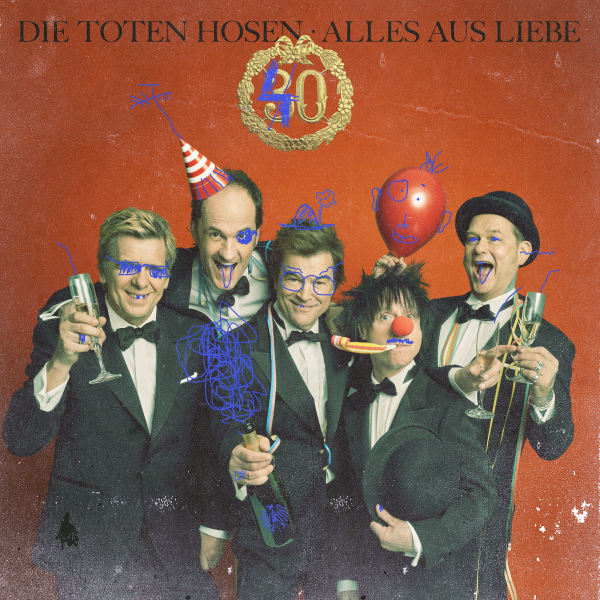
Wow, Die Toten Hosen have been around for 40 years already.
When did my journey with Die Toten Hosen begin? It was a concert at the now-defunct Deutschlandhalle in Berlin. After that, Die Toten Hosen had won me over, and I remained loyal to them for a long time. I attended countless concerts, soaking up the music and the lyrics, and when things were really going well, we’d sometimes meet up at the Enzian, the now-defunct bar owned by the real Heino in Berlin-Kreuzberg.
Unfortunately, that didn’t last forever.
The rafters creaked, then dust trickled down, the first chunks fell, and finally the building collapsed. The reasons were manifold. I found “Unsterblich” only mediocre, and I found their treatment of the Yeti Girls from Cologne—because they sang “I would never go to see Die Toten Hosen”—more than embarrassing.
They could dish it out but couldn’t take it.
That was the end of it for me with the five guys from Düsseldorf.
Now I’m turning 40 and I’m getting back into the band.
40 years, 43 songs. That’s a lot, and yet not enough to cover the band’s entire body of work. A few old classics are included, as well as a few new songs.
The songs aren’t arranged chronologically, which is what I would have preferred. That way, you could trace the band’s evolution, and even for someone like me, who hasn’t followed the band closely for years, it would be easier to place the songs in their proper chronological order.
So there are songs from every era that were particularly popular, particularly important, or particularly successful. That sounds like a massive “Best Of” compilation, and that’s exactly what it is.
It’s fun to listen to and lets me reminisce.
The new songs show what Die Toten Hosen are like today, and I have to say—even if I take off my critical glasses—it doesn’t really get me going anymore, but let’s do it like Campino, who wrote short notes for each song.
3 CHORDS FOR A HALLELUJAH!
Four Fists for a Hallelujah is already taken by Bud Spencer and Terence Hill.
The musician also tends to play with chords. Although, Die Hosen and a musician? Did I miss something here? An intro like it’s for the next Italo-Western. Here, the new track opens the retrospective and shows that Die Hosen can (or could) do film music too.
EVERYONE SAYS SO:
A really good punk rock song with great lyrics. It really drives forward, a great mosh pit track, and shows that Die Toten Hosen still know how it’s done.
FUCK THE WESSIS:
The video is a blast, and the lyrics are great too. Pretty poppy, but live this thing is likely to get stadiums singing along in unison. A song for the generation that lived through East and West and for whom the border still exists in their minds. But the border is also very real—for example, in many sectors, wages for the same work are lower in the East than in the West. Will that ever change?
AMORE FELICE
The guitar intro is powerful. The melody is typical Die Toten Hosen. They could get a copyright on that. Lyrically a bit too naive for my taste. Since Die Toten Hosen have written this kind of song many times before, it’s just standard fare.
TEUFEL
The intro is okay, but what follows is a pretty cheesy, schmaltzy piece of music. Is that really necessary? Is this still Die Hosen?
112
Musically, the Düsseldorf band has finally arrived at the depths of mainstream pop. I don’t even want to know what this looks like in the stadium. Do they really have to celebrate themselves with such an embarrassing number?
CHAOT (IN MIR)
Here we have heavy guitars and a thick drum beat again. Great sound-wise, but with this song, too, the band is celebrating itself too much.
What remains?
For me, the confirmation that I parted ways with Die Toten Hosen at the right time, but also that Die Toten Hosen, when they want to, can still play really good punk rock.
These days, in keeping with their age and success, they’re more like stadium rockers with their fists in their pockets (I miss that important song in this retrospective).